Dolby Audio vs Dolby Atmos: Key Differences, Real-World Use Cases, and How to Choose

You’ve probably come across Dolby Audio vs Dolby Atmos more times than you can count. They show up on TVs, headphones, streaming apps, even buried in phone settings. Since both come from Dolby Laboratories, it’s easy to assume they’re just different labels for the same upgrade. They’re not. One is about refining the sound systems most of us already use, making them clearer and more consistent. The other changes how sound itself is positioned around you. Understanding when that gap matters, and which one you should choose, is what this article is really about.
What Is Dolby Audio?
Dolby Audio comes from Dolby Laboratories, and it’s built into a lot of everyday devices by default, TVs, laptops, streaming platforms, and plenty of headphones. It’s there so dialogue doesn’t get buried, explosions don’t spike the volume, and quiet scenes don’t feel hollow. When Dolby Audio is working, the sound feels steadier and easier to listen to.
Dolby Audio Technology
Dolby Audio is there for one simple reason: most sound setups aren’t very good at sorting things out on their own. When you’re watching a movie, the dialogue, music, and background noise all arrive at the same time. If nothing manages that mix, voices sink, music swells too much, and sudden loud scenes feel harsher than they should.
Dolby Audio steps in to keep that from happening. It uses a channel-based mix where sounds already have assigned roles, dialogue stays centered and clear, music fills the space around it, and environmental noise stays in the background. When you hit play, the system tweaks that mix depending on what you’re listening to. TV speakers, a laptop, or headphones all get adjusted slightly differently. The point is making sure nothing feels thin, muddy, or tiring.
Key Benefits of Dolby Audio
Once you know what Dolby Audio is doing behind the scenes, its benefits show up in small but noticeable ways during everyday listening.
1. Clearer Dialogue
Voices tend to come through in a more natural way. You don’t have to strain to catch what someone just said, even when there’s music or background noise layered in. It feels less like the sound is fighting itself and more like speech has its own space.
2. Loudness Leveling
One thing people notice quickly is how little they touch the volume button. Loud scenes don’t suddenly jump out, and quiet moments don’t fade into nothing. The sound stays within a comfortable range, which makes watching for long stretches less tiring.
3. Virtual Surround Effects
The sound doesn’t feel locked to a single point. Even with simple speakers or headphones, audio spreads out a bit, giving scenes more breathing room. It’s not dramatic or flashy, just enough to keep things from feeling flat or boxed in.
4. Consistent Performance Across Devices
When you switch between devices, Dolby Audio automatically adapts the sound to fit what you’re using. Whether it’s TV speakers, headphones, or a laptop, voices stay clear, levels stay balanced, and the overall sound keeps its sense of depth instead of falling apart.
What Is Dolby Atmos?
Dolby Atmos shifts the attention toward how sound is placed around you. When people ask what is the Dolby Atmos, what they want to know is not only the Dolby Atmos meaning, but they’re usually curious about the difference it makes. Instead of sticking sounds to specific speakers, it allows them to feel more spread out and layered within the listening space.
Dolby Atmos Technology
In an Atmos mix, a sound, let's say a helicopter, is treated as an "object." The sound engineer doesn't tell it to go to the "left surround speaker." They tell the software to "move the helicopter object overhead from left to right."
Your receiver or processor then figures out exactly which speakers to fire to recreate that movement in your specific room. This allows for the inclusion of height channels (speakers in the ceiling or firing upward), creating a dome of sound rather than just a flat circle around you.
Advantage of Dolby Atmos
Here are the main advantages of Dolby Atmos and why it stands out.
1. Immersive Sound Experience
Because sound can come from above, you feel enclosed in the environment. Rain sounds like it's hitting the roof; birds sound like they are in the trees above you. It removes the "gap" in the soundstage that traditional surround sound often has.
2. Precise Audio Positioning
In competitive gaming, this is huge. You don't just hear footsteps "behind you." You hear them "behind you, slightly above, and to the left." The precision is far sharper than standard channel-based mixing.
3. Better for Home Theaters, Gaming, and Movies
“Atmos scales” means it works with different speaker setups. A 9.1.4 home theater adds dedicated height speakers on top of a standard surround system, which makes the effect more noticeable. With fewer speakers, Atmos still adapts the sound placement to match the hardware. This flexibility makes it ideal for everything from dedicated home theaters with multiple height speakers to simpler gaming or movie setups.
Dolby Audio vs Dolby Atmos: The Core Differences
Here is the breakdown of how these two technologies stack up against each other.
1. Sound Processing
When looking at sound quality unpacked, you can see that Dolby Audio focuses on reliability and clarity, cleaning up the signal, while Dolby Atmos renders a simulation, calculating physics in real-time to decide where sound should come from.
2. Surround Sound Capabilities
Dolby Audio supports traditional surround layouts such as 5.1 and 7.1, where sound is distributed across fixed speaker positions around the listener. Dolby Atmos expands on this by adding height channels and flexible speaker layouts, supporting home setups with up to 34 speakers, allowing sound to move more freely above and around the listening space.
3. Immersion and Realism
Dolby Audio feels like watching a play from the audience. Dolby Atmos feels like standing on the stage with the actors.
4. Device Compatibility
Dolby Audio is built on a mature standard with broad compatibility, making it widely supported across TVs, soundbars, laptops, and everyday audio devices. Dolby Atmos, by comparison, relies on full-chain support to reproduce three-dimensional sound, so it is more commonly found on devices designed for immersive audio playback.
|
Feature |
Dolby Audio |
Dolby Atmos |
|
Core Technology |
Channel-based (e.g., 5.1, 7.1). Sound is assigned to specific speakers. |
Object-based. Sound is treated as an object that moves in 3D space. |
|
Sound Processing |
Focuses on clarity, volume leveling, and optimizing standard surround signals. |
Focuses on spatial accuracy and height information (3D audio). |
|
Surround Capabilities |
Horizontal only (Left, Right, Center, Surround Left/Right). |
Horizontal + Vertical (height channels allow sound from above). |
|
Immersion and Realism |
High. Creates a wide soundstage, but sound remains on a flat plane. |
Extreme. Creates a "dome" of sound with precise location tracking. |
|
Device Compatibility |
Universal. Works on almost all modern TVs, PCs, and streaming boxes. |
Specialized. Requires Atmos-supported hardware and source content. |
Popular Devices Supporting Dolby Audio and Dolby Atmos
Different devices support different Dolby formats. It depends on their hardware capabilities. Here’s a closer look at which gadgets use Dolby Audio and which support Dolby Atmos.
Dolby Audio Devices
Projectors: Many portable projectors use Dolby Audio to squeeze decent sound out of their small internal speakers, ensuring dialogue cuts through the fan noise.
Headphones: Dolby Audio is widely used in headphones and headsets to improve clarity and balance, making voices, music, and game effects stand out clearly. The consistent and high-quality audio is essential.
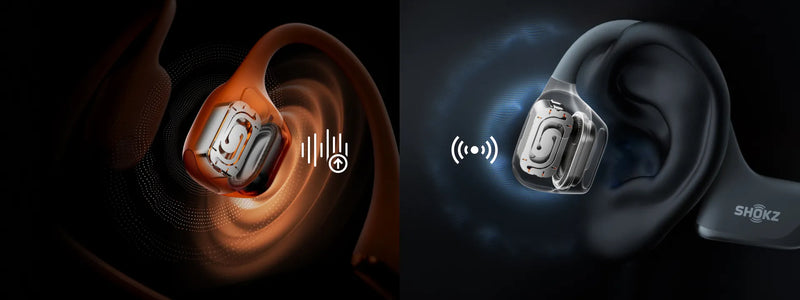
If you’re looking for a headset that delivers this rich, clear sound, OpenDots ONE offers a great balance. Its feather-lightweight clip-on design and Dolby Audio processing work together to provide a natural experience while keeping you comfortable for long listening sessions. It relies on processing and driver layout to create depth and separation.

-
Dolby Audio widens the soundstage slightly, so music, dialogue, and effects don’t feel stacked on top of each other.
-
Bassphere™ Technology in Shokz open ear headphones uses a compact spherical structure with dual drivers to give sound more body than typical open-ear designs.
-
EQ presets make it easy to adapt the sound for different content without chasing volume changes
Gaming Consoles: Older consoles (like the PS4 or Xbox One) rely heavily on Dolby Audio formats for their surround sound output via optical or HDMI.
Soundbars & Speakers: Entry-level to mid-range soundbars almost always support Dolby Audio. It is the industry standard for decoding the signal coming from your cable box or DVD player.
Laptops & PCS: Windows laptops often feature "Dolby Audio" drivers. This is software-side processing that equalizes your laptop speakers to prevent them from sounding tinny or harsh.
Dolby Atmos Devices
Home Entertainment Systems: To get the "real" Atmos experience, you need an AV receiver and ceiling speakers (or upward-firing modules). These systems decode the height data to physically bounce sound off your ceiling.
Television and Streaming: Modern 4K smart TVs often have built-in Atmos decoding. They can pass the Atmos signal to a soundbar or attempt a virtual Atmos effect using their internal speakers.
Mobile and Personal Devices: Many flagship phones support Dolby Atmos. Obviously, a phone doesn't have ceiling speakers. Instead, it uses "binaural rendering" to trick your ears into hearing 3D height effects through stereo speakers or headphones.
How to Choose between Dolby Audio and Dolby Atmos?
You don’t always have to choose one over the other. While many Atmos-capable devices can also handle Dolby Audio content, the real decision depends on how you plan to use your gear and what your setup can actually support.
Consider Your Listening Purpose
If you primarily watch the news, YouTube, or broadcast TV, Dolby Audio is plenty. You want clear voices and steady volume. For everyday entertainment to listen and watch, you don’t need a helicopter flying over your head to watch the weather report.
If you are a film buff, subscribe to the premium tier of Netflix, or play AAA video games, Dolby Atmos is worth the extra investment. The immersion in movies like Dune or games like Call of Duty is noticeably superior.
Check Device Compatibility and Setup
There is no point in paying for an Atmos soundbar if your TV can't output the signal. You need a chain of compatibility:
-
Source: The movie/game must have an Atmos track.
-
Player: The streamer (Roku) must support Atmos.
-
Display/Audio: The TV or Soundbar must be Atmos-enabled.
If any link in that chain is broken, the system falls back to a standard Dolby Audio format or a non-Atmos audio output supported by the device.
Evaluate Portability and Device Flexibility
For on-the-go listening, Atmos headphones are becoming popular, but standard Dolby Audio headphones are often more battery-efficient and cheaper. For daily commuting, a straightforward setup often works better. Dolby Audio earbuds focus on clarity and balance, without relying on heavy spatial effects. In real-world noise, this kind of tuning can feel more consistent than virtual 3D sound.
FAQ
1. Does Dolby Audio mean stereo only?
No. Stereo is just one way it can play back. Dolby Audio also handles surround mixes. The goal isn’t channel count, but keeping sound from falling apart when scenes get loud or quiet.
2. Do all Atmos headphones provide the same immersive experience?
Not at all. Some barely feel different. Others make the space obvious. Fit, driver tuning, and how your ears sit in the headphones matter more than the Atmos label.
3. Does Dolby Atmos work with wireless headphones?
Yes, but only in a limited, simulated way. Your phone or TV does the Atmos processing first, then sends the sound to the wireless headphones over Bluetooth. You get a wider, more spacious feel, but not true surround like speakers placed around a room.
4. How to experience Dolby Atmos at home?
Most people don’t start with ceiling speakers. A soundbar is common. Full setups sound impressive, but they take time, money, and a room that can handle it.
5. Do all headphones support Dolby Audio and Dolby Atmos?
Not always. Most headphones support Dolby Audio. However, almost all headphones don’t truly reproduce full Dolby Atmos. In practice, Atmos on headphones is usually a virtual effect created by the source device.
Conclusion
Dolby Audio vs Dolby Atmos aren’t meant to replace one another. They exist for different listening situations. Dolby Audio keeps surround sound organized, dialogue easy to follow, and volume from jumping all over the place. Dolby Atmos can add more depth, but only when the full setup supports it from start to finish. If the content, device, and speakers line up, the sense of space can stand out. What matters most is how you listen and what your gear is actually capable of handling, not which logo shows up first.