How Wind Noise Reduction Headphones Keep Calls Clear Outdoors

We’ve all been there. You’re halfway through a scenic coastal ride or crushing a sunset personal best on your favorite trail, and an important call comes in. You answer, full of adrenaline, only for the person on the other end to yell, "I can't hear you! Are you standing behind a jet engine?"
In 2026, wind remains the "final boss" of outdoor audio. But why does a moderate breeze sound like a hurricane through a microphone? To reclaim your outdoor conversations, we have to look at the science behind the scream.
Part 1. The Physics of Frustration: Why Wind is the Enemy of Clear Audio
To understand why wind is so destructive, we have to look at Acoustic Turbulence. When air flows over the hard surface of a headphone, it doesn't move smoothly; it creates tiny, chaotic whirlpools called "vortices."
-
The Diaphragm Struggle: According to research on Aeroacoustics, when these vortices hit a microphone's sensitive diaphragm, they create massive pressure fluctuations. This isn't "sound" in the traditional sense—it's mechanical noise caused by physical impact.
-
The Failure of Traditional ANC: Many users confuse the solutions, but there is a major difference when comparing noise reduction vs. noise cancellation. Traditional Active Noise Cancellation (ANC) is designed for predictable sounds like a plane engine. Wind is chaotic and non-linear; when standard chips try to "counter" it, they often create digital artifacts that make you sound like a glitchy robot.
Part 2. AI vs. Mechanical Buffering: A Two-Front War
In 2026, the industry has moved beyond simple noise suppression toward intelligent environment management. This requires two lines of defense:
Mechanical Defense: The Physical Shield
Before the software even sees the signal, the hardware must do the heavy lifting. Elite devices use micro-perforated stainless steel meshes that break large air masses into micro-streams, drastically reducing their kinetic energy before they hit the microphone sensors.
Part 3. AI Suppression: The Rise of Real-Time NPU Processing
The real breakthrough in 2026 is the Neural Processing Unit (NPU). Unlike old-school processors, an NPU acts like a trained human ear. It can instantly distinguish between the chaotic energy of a gust and the specific harmonic frequencies of your voice. Through an advanced noise reduction process, the NPU "carves" the wind out of the audio stream in under 5 milliseconds, ensuring zero lag during a conversation.
Part 4. Shokz Custom Wind-Control: Professional Performance
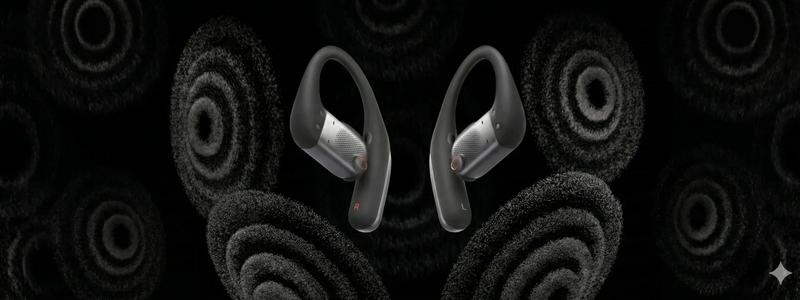
Shokz has spent years perfecting the balance between staying open to the world and staying clear on the line, while delivering open ear security and comfort through its open-ear approach. Designed for the demands of pro-level movement, the Shokz OpenFit Pro utilizes a specialized Triple-Microphone Array.
This system doesn't rely on just one mic. It uses a "best-of-three" logic: if the front mic is getting hammered by a headwind, the NPU instantly switches priority to the shielded rear or side mics. This ensures that even when you are descending at 25 mph, your voice remains the star of the show.
Part 5. The Open-Ear Challenge: Reducing Wind Without the Seal
Open-ear designs face a unique hurdle. Unlike in-ear buds that rely on physical noise isolation, open ears allow wind to rush naturally toward the canal.
Shokz engineers solved this with aerodynamically "slippery" housing. The curves of the device are designed to guide airflow around the acoustic vents rather than into them. This structural innovation allows the core Open-Ear Noise Reduction Technology to work in a cleaner environment, focusing its power on your voice rather than fighting the air itself.
Part 6. 5 Tips to Minimize Wind Noise During Your Workouts
-
Check the "Seal" of the Hook: Ensure the ear hook is snug against your temple. A gap can create an "acoustic whistle" at high speeds.
-
App EQ Optimization: Use the Shokz App to select "Vocal Mode" during windy days. This filters out low-end rumble and boosts speech frequencies.
-
Use Your Head: If you are stationary and on a call, turn your head slightly. Using your own cheek as a "windbreak" for the microphones can improve clarity by 10-15dB.
-
The Headband Trick: A light, breathable sports headband over your ears acts as a "deadcat" (the fuzzy covers on professional mics), providing perfect physical wind protection.
-
Steady Your Pace: Dropping your speed just slightly (e.g., from 18mph to 15mph) can exponentially reduce the aerodynamic noise floor.
FAQs About Wind Noise
Q1. Why do I hear a whistling sound in high wind?
This is often caused by air rushing through a tiny gap between the headphone and your ear. Adjusting the fit to eliminate that gap usually fixes the problem.
Q2. Can a software update really improve "physical" wind noise?
Yes. While the wind is physical, the extraction of your voice is algorithmic. As AI models improve, NPU updates help your headphones better distinguish your voice from new, complex wind patterns.
Conclusion
In 2026, the sound of the wind shouldn't be the sound of a disconnected conversation. By combining aerodynamic hardware with the surgical precision of AI NPU processing, the OpenFit Pro has finally closed the gap between being active and being heard.
You can also explore OpenFit 2 Plus comfort to discover another approach to all-day open-ear listening.