How to Adapt to Weightless Ear Clip Earbuds: Fit, Pressure & Daily Wear Tips

If you frequently reach up to check if your ear clip earbuds are still attached, you're navigating a typical part of the open-ear transition. That "barely there" sensation often feels like a loose fit at first.
Without the snug pressure of traditional silicone tips, the sudden lack of weight often leaves a lingering suspicion that they might slip off.
However, this rarely points to an actual fit failure. Let's explore what is really happening and how to comfortably settle into this near-weightless design.
Why Getting Used to "Weightless" Ear Clip Earbuds Starts With Your Brain
Why Your Brain Interprets Low Weight as Instability
If your ear clips feel loose despite being positioned correctly, it usually comes down to sensory habit. Many of us are conditioned to equate a "secure fit" with the deep, physical pressure of traditional in-ear silicone tips.
When explaining what are clip-on earbuds, the key difference is that they typically rest gently on the outer cartilage rather than sealing the canal, meaning that familiar pressure cue is largely removed.
As a result, your brain can easily misread this lighter sensation as instability. In many cases, it isn't an actual loose fit—your ears are likely just searching for a level of pressure they won't find with an open design.
How Long Does It Take to Get Used to Ear Clip Earbuds?
Typically, this adjustment period spans about a week. The first day often feels the strangest, leading to constant fit-checking. However, by days three or four, that urge tends to fade, and by the end of the week, many users stop noticing the earbuds entirely.
This transition is incredibly common across the open-ear community. As one Reddit user accurately summed up their own experience, "I believe that after a while, your ears will adapt, and they will be far more comfortable... it always gets better."
As long as the fit isn't painful, giving your senses a few days to recalibrate is often all it takes to find that sweet spot.
How to Tell the Difference Between Normal Unfamiliarity and a Real Fit Problem
If what you feel is mostly mental awareness—like constantly noticing the earbuds, checking them, or feeling unsure because they are so light—that points to normal adjustment. If the earbuds stay in place during normal talking, head turns, and walking, the fit is probably fine even if it still feels unfamiliar.
If what you feel is physical pressure, pinching, skin irritation, repeated slipping from the same spot, or one side refusing to sit securely no matter how you place it, that points more toward a real fit issue.
The simplest rule is this: unfamiliarity fades with time; physical mismatch repeats in the same way every wear.
How to Get Used to Ear Clip Earbuds That Feel Almost Weightless by Positioning Them Correctly
While your brain adjusts to the lighter weight, figuring out exactly how to wear clip-on earbuds is just as important. Proper placement typically helps secure that weightless feel without adding unnecessary pressure.
Where Exactly the Clip Should Sit on Your Ear
Ideally, the clip should gently anchor onto your outer cartilage, keeping the speaker resting near the ear opening without pushing inward. You want a balanced, flush fit rather than a dangling sensation. If the earbud seems to stick out or feels unstable, it usually just needs a slight adjustment along the ear's edge, rather than extra pressure.
Step-by-Step: How to Seat the Clip Without Overforcing It
Hold the earbud by the outer body instead of the speaker area.
You should feel like you have control of the clip without pressing on the sound side.
Place the clip onto the outer ear at the natural anchor point above the anti-helix.
You should see the earbud rest against the ear rather than hang below it.
Set the speaker side so it sits near the ear opening, not inside it.
You should notice open-ear placement with no plugged or clogged feeling.
Release the earbud gently once the clip is balanced.
You should feel light contact instead of a tight squeeze.
Resist the urge to press the driver toward the canal.
You should still hear audio without needing the earbud shoved inward.
The most common day-one mistake is trying to make an open-ear earbud behave like an in-ear bud. If you push it inward to “lock it in,” you usually make the fit feel less natural, not more secure. Let’s break down why this happens: open-ear designs are meant to rest, not seal.
How to Adjust for Smaller or Larger Ears
For smaller ears, try angling the device so the clip rests flat against the back of your ear. A flush fit typically prevents the earbud from tilting outward and feeling top-heavy.
If you have larger ears, ensure the clip wraps deep enough around the cartilage rather than just perching on the very edge. A slightly deeper placement often provides better balance and support, as long as it doesn't pinch.
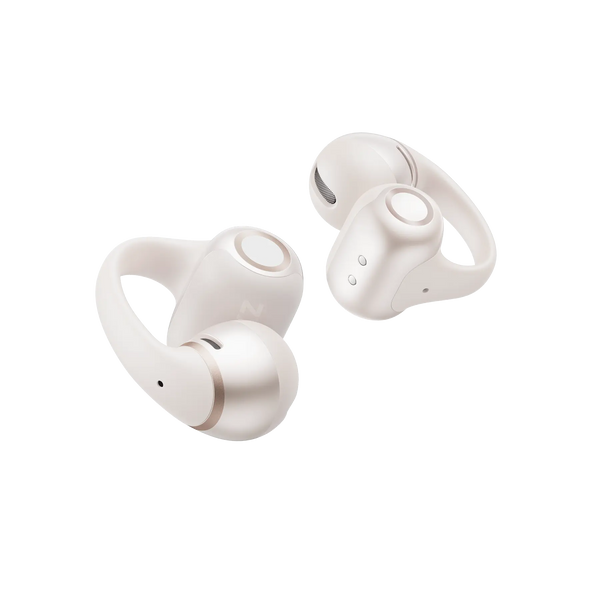
If adjusting feels endless, consider adaptable hardware like the Shokz OpenDots 2. Its flexible Ni-Ti memory core typically contours to any ear without pinching. For audio, Bassphere™ 2.0 cuts distortion, while Dolby Audio adds depth, letting you enjoy a spacious, lifelike soundstage without shoving the earbuds inward.
How to Check That the Fit Is Secure Before You Start Moving
Do a quick self-test before you leave the house or start a workout. Shake your head lightly. The earbud should stay put without bouncing loose. Move your jaw as if chewing or talking. The earbud should remain stable without shifting forward. Press once with a single finger near the outer body. It should feel seated, not wobbly.
If the earbud passes those 3 checks, the fit is usually secure enough for everyday use. If it fails one of them, reposition before increasing movement instead of assuming the product is the problem.
How to Wear Clip-On Earbuds: A Progressive Schedule for Weightless Comfort
If you want to smoothly transition into this new style, pacing yourself can be incredibly helpful. Rather than jumping straight into a heavy workout, giving your senses a chance to build trust with the device often makes a big difference. Here is a gentle, suggested progression that many new users find effective:
|
Timeline |
Activity Level |
The Goal & What to Expect |
|
Days 1–2 |
Low: Desk work, reading, or lounging |
Let your senses adjust to the lightweight profile without the stress or distraction of body movement. |
|
Days 3–4 |
Moderate: Walking, light chores, or running errands |
Introduce natural head and jaw movements. This helps your brain realize that "light" does not mean "loose." |
|
Days 5–7 |
High: Workouts and heavier activities (if applicable) |
By this stage, you are typically no longer over-monitoring the fit, allowing you to trust the stability. |
By the end of this first week, that constant urge to check the earbuds usually fades. If you browse open-ear communities online, you'll see this transition mentioned quite often.
One user on Reddit summed up their own turning point nicely: "Unlike most clips, I actually really do forget that I’m wearing them and they just stay put." Getting to that exact stage—where the fit feels like second nature—is what this brief adjustment period is all about.
How to Get Used to Ear Clip Earbuds That Feel Almost Weightless When the Audio Sounds Different
Once your brain gets comfortable with the physical feel of the ear clips, you might notice another major difference: the audio itself. Transitioning to an unsealed design changes how you perceive sound, and giving your ears time to adapt to this new acoustic profile is just as important as finding the right physical fit.
Why Open-Ear Sound Feels Quieter or Thinner at First
If the audio initially seems slightly thinner or quieter, it rarely means you are wearing them incorrectly. Because these clips don't seal your ear canal, you typically lose the heavy bass and passive isolation associated with traditional silicone tips. This is a very common experience, and your ears usually just need a little time to adjust to this more spacious, breathable soundstage.
How to Use EQ Settings to Find Your Preferred Sound Profile Early On
While adjusting, exploring your earbuds' companion app can make a big difference. Before assuming the default tuning isn't for you, try experimenting with the built-in EQ presets. Give each setting a full listening session rather than rapidly switching back and forth. This approach allows your ears enough time to genuinely settle into a profile, helping you pinpoint the vocal clarity or bass balance you prefer.
When to Use Volume Differently in Open-Ear vs. Noisy Environments
In quiet spaces, try starting with a lower volume than usual; open-ear audio often sounds most natural when it blends with your surroundings. In noisier environments, try to resist the urge to instantly crank it up. The instinct to overpower background noise usually stems from expecting in-ear isolation. If you constantly need maximum volume, the environment might simply be too loud for comfortable open-ear listening.
How to Get Used to Ear Clip Earbuds That Feel Almost Weightless — And When Adaptation Tips Won’t Fix It
If you have given it a full week and are still struggling, the specific shape of your clip-on earbuds might just not be the right match for your ear anatomy. To figure out if it is time to stop trying to adapt, you can easily test a few physical fit factors:
-
Assess the contact area: The clip should rest evenly against your ear. Try wearing them for 10–15 minutes while simply sitting quietly. If you notice a sharp pinch or soreness rapidly building in one tiny spot, extra patience is less likely to solve the issue.
-
Test the natural tension: Clip-on earbuds typically feel stable without extra help. If they frequently rotate out of place or only feel secure when you actively push them inward, the shape compatibility is likely off.
-
Check for asymmetry: Sometimes one ear adapts perfectly while the other just won't cooperate, which often points to a true size or shape mismatch.
Ultimately, a good fit should feel comfortable, secure, and effortless—holding steady like a gentle clip without needing to sit inside the ear canal. If you aren't experiencing that after a reasonable break-in period, it usually means this specific design just isn't the one for you.
Conclusion
Transitioning to a near-weightless fit is mostly a mental shift. Once your brain stops expecting deep in-ear pressure, that "barely there" sensation typically becomes incredibly freeing.
Give your senses a week to adapt to this style. If you want a design built specifically to ease this transition, Shokz open ear headphones are engineered to balance open-ear stability with exceptional comfort. Ultimately, when you reach the point where you genuinely forget you are wearing them, you are well on your way to a completely natural listening experience.